Featured

Introduction

I’m Magnus Lundberg, Professor of Church and Mission History in the Department of Theology at Uppsala University, Sweden. Through the years, much of my research has focused on colonial Latin American church history. Still, from 2015 onwards, I have devoted much time to the study of Catholic traditionalism, Fringe Catholicism, and New Religious Movements with Catholic roots, especially modern alternative popes (“antipopes”).

On this website, I publish research papers and drafts on topics that interest me. Most articles are in English, but some are in Spanish or my mother tongue, Swedish. Some have been published elsewhere (as books or articles), but they are now available open-access here. Some texts are written exclusively for this site.

Contact: magnus.lundberg@teol.uu.se

For more information on my research and publications, see the “about-section”

For my series of articles on the Palmarian church, see the Palmarian page

For my series of articles on modern alternative popes, see the Pope page

For my series of articles on Giuseppe Maria Abbate, the Celestial Messenger, see the Celestial Messenger Page

For articles and monographs on Latin American church history, see the Church and Mission Studies page

For a great non-academic interest of mine, see the fountain pen pages. This part of the website is in Swedish. Om du är intresserad av äldre pennor är du välkommen att besöka den del av sidan som behandlar reservoarpennor.
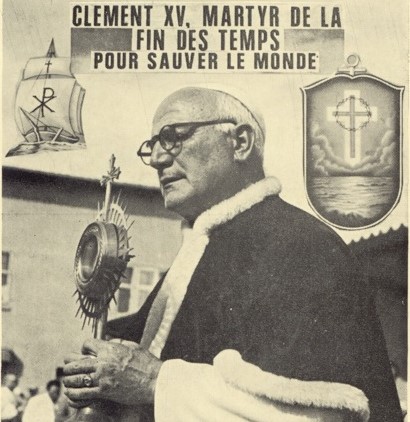
The 50th Anniversary of the Order of the Carmelites of the Holy Face

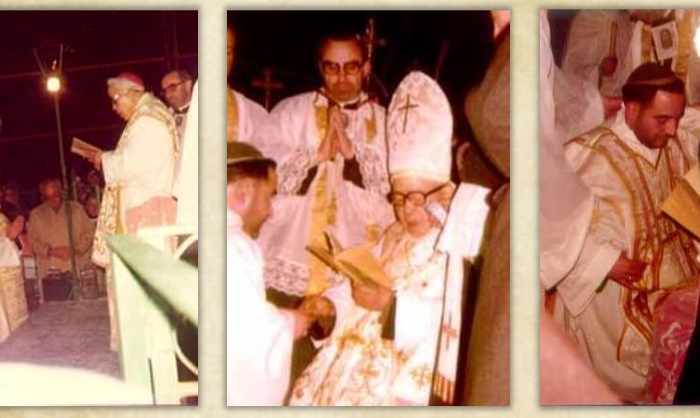
The 50th Anniversary of the Order of the Carmelites of the Holy Face

Today, December 23, 2025, marks the 50th anniversary of the Order of the Carmelites of the Holy Face, the congregation that today forms part of the Palmarian Catholic Church, based at El Palmar de Troya, an apparition site in Spanish Andalusia. The Church was founded in 1978, when the superior of the Orden, Clemente Domínguez y Gómez (1946-2005) proclaimed that he was true pope of the Catholic Church and the Holy See was transferred to El Palmar de Troya/Seville. Still, the foundation of the Order was an important step.

Throughout the last decade, I have published much about the Palmarian Church, and the following is an extract from my book A Pope of their Own: El Palmar de Troya and the Palmarian Church (1st edition 2017, 2nd edition 2020)

Continue reading “The 50th Anniversary of the Order of the Carmelites of the Holy Face”

The Alternative Pope Project

The Alternative Pope Project

In 2015, I started the Alternative Pope Project. The goal was to identify and study individuals who, during the 20th and 21st centuries, claimed that they, and not the more well-known figure in Rome, were the true leader of the Catholic Church. To refer to them, I coined the term alternative popes.

I soon realized that it would be difficult to find sources about many of the claimants, as little material is found in research libraries. To solve the problem, I created this website. Initially, I wrote brief posts on the papal claimants I knew, asking for more information.

I was amazed by the feedback. Over the past almost ten years, several thousand people have contacted me.  Many have asked questions, wanting to know more, and many have helped me access source material or shared their experiences as (former) members of these groups. With their help, I have been able to amass considerable material, and I have been able to publish several more substantial texts that, in their turn, have led to new contacts and even more sources.

This project’s final outcome will be a sizeable monograph: Could the True Pope Please Stand Up: 20th and 21st-Century Alternative Popes. Hopefully, I will be able to finish it in 2026, thus ending a decade-long project.

To date, I have produced five monographs, five group profiles, and more than a dozen research reports listed below. I have also published ca. 50 blog posts, including brief studies on alternative popes and scanned sources.

Continue reading “The Alternative Pope Project”

Images of the Celestial Messenger. Part 7.

Images of the Celestial Messenger. Part 7.

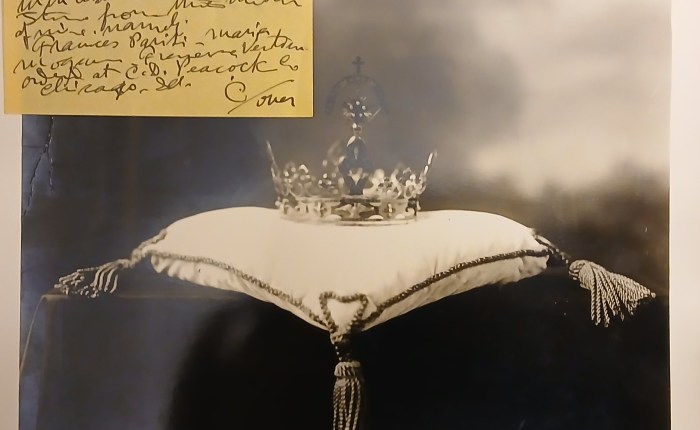
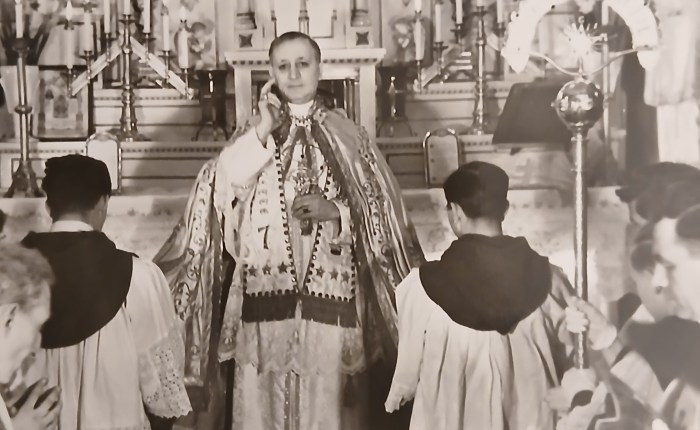
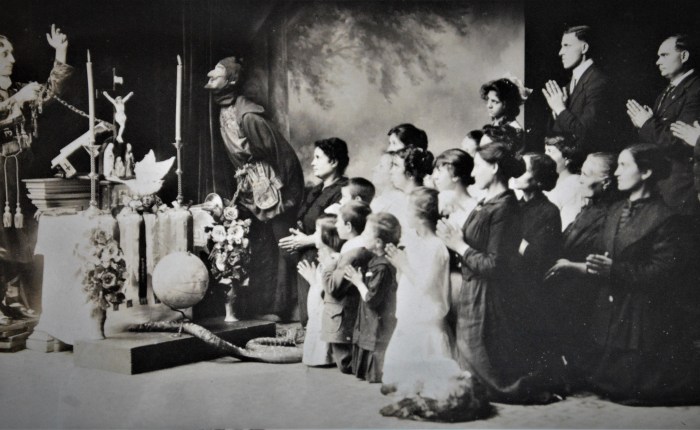
This is the seventh and last part of the series of images from the archives of Italian-American Giuseppe Maria Abbate (1886-1963), the Celestial Messenger, who claimed to be divine. For more pictures and studies, see the Celestial Messenger page.

The focus of Abbate’s Church, the New Jerusalem Church, was his claims of divine status and his role in salvation history. From the early 1910s, he was known as the Celestial Messenger. Later, his title became Padre Celeste. Still, he also referred to himself as the Universal Protector, St. Michael the Archangel rehumanated, the Prince of Peace, God’s Vicar on Earth, and the Celestial King. Thus, Abbate claimed to be something of a combination of a pope, an archangel, a prophet, a king, and God incarnate.

In his interpretation, each first letter in his full name and title, “Giuseppe Maria Abbate di Carmelo, Padre Celeste”, had a symbolic meaning in Italian, summarizing his mission on earth. In English translation, it was: Jesus, Incarnate, Made Human, Most Holy Immanuel, Eternal Prince of Peace, sent to be reincarnated in Abbate to Bless Everybody Eternally. Divinity Incarnate. Celestial Angel, King, Immanuel, the Messiah Arrived, the Ordained Angel. The Door to God. Elected Religious. Christ, Immanuel, Eternal Light, the Sound of the Seventh Trumpet.

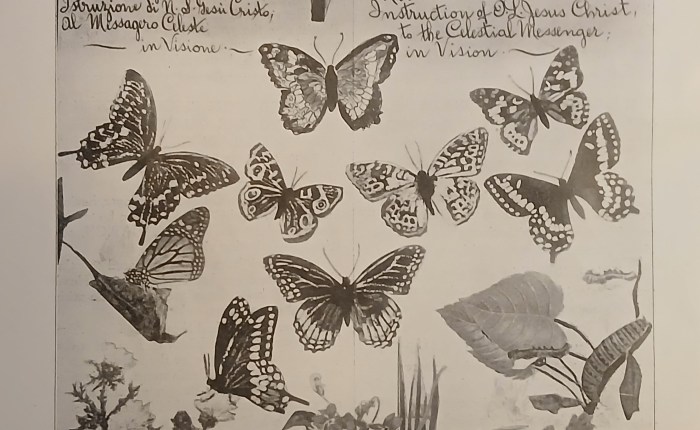
While he believed he possessed supernatural powers already from the beginning of the 1910s, in 1923, Abbate claimed that Christ had appeared to him, showing him the transformation of a caterpillar into a butterfly. From that moment, Abbate was convinced that he was “Jesus rehumanated.” His face was the true face of Christ in the modern era. At the same time, Abbate began to claim that he had lived on Mars before coming to Earth in 1886.

Continue reading “Images of the Celestial Messenger. Part 7.”

Images of the Celestial Messenger. Part 6.

Images of the Celestial Messenger. Part 6.

This is the sixth part of my series of images of Giuseppe Maria Abbate (1886-1963), the Italian-American Celestial Messenger. See part 1, part 2, part 3, part 4, and part 5. It includes photos of objects found in my collection related to Abbate and his New Jerusalem Catholic Church. These objects include a trumpet, two processional swords, and a box containing relics (mainly hair, beard, and nail clippings).

Continue reading “Images of the Celestial Messenger. Part 6.”

Images of the Celestial Messenger. Part 5.

Images of the Celestial Messenger. Part 5.

This is the fifth part of my series of images of Giuseppe Maria Abbate (1886-1963), the Italian-American Celestial Messenger. They are part of my collection of documents related to Abbate and his New Jerusalem Catholic Church. See part 1, part 2, part 3, and part 4.

Most of the photos in the collection depict the Celestial Messenger, the Reincarnated Virgin Mary, and religious ceremonies or objects related to them. Copies of these pictures were held by Church members and were also part of Abbate’s missionary activities, distributed to potential adherents. Some were also printed in the Church’s newspaper, L’Araldo, published between 1926 and 1928, as well as in brochures and booklets.

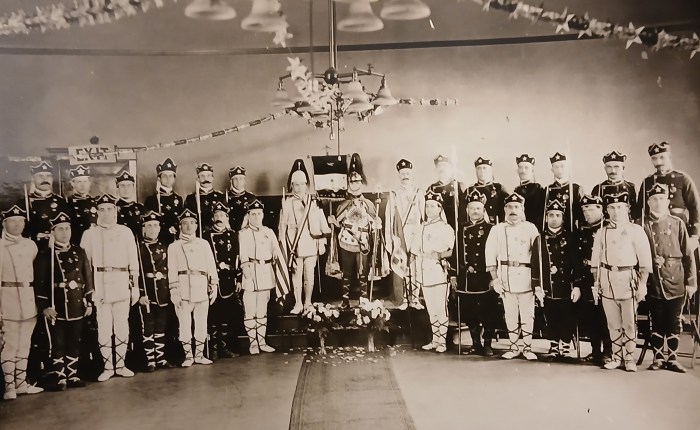
However, the collection also includes other photos documenting members, both individuals and groups. There are, e.g., pictures of the Celestial Messenger’s honorary guard, members of the girls’ and boys’ groups, nuns, religious brothers, and ordinary faithful.

Continue reading “Images of the Celestial Messenger. Part 5.”

Images of the Celestial Messenger. Part 4.

Images of the Celestial Messenger. Part 4.

This post is the fourth part of my series of images of Giuseppe Maria Abbate (1886-1963), the Italian-American Celestial Messenger. They are part of my collection of documents related to Abbate and his New Jerusalem Catholic Church. See part 1, part 2, and part 3.

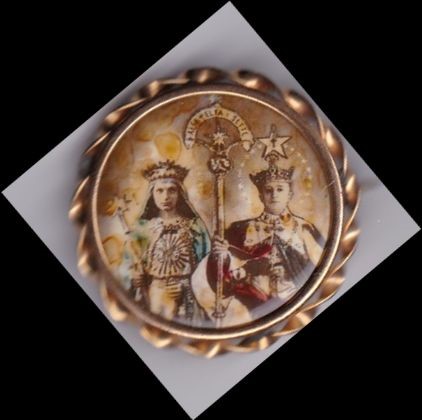
However, in this part, the focus is not on Abbate, but on a girl, Grace, whom he and his Church believed to be the reincarnated Virgin Mary. Grace was born in Chicago in 1915. Both her parents were born in Italy and had recently emigrated to the United States. When she was newly born, Abbate became convinced of her true identity.

Just as Abbate, the reborn Virgin Mary, took a prominent place in religious services, both sitting on thrones. Grace left the church when she was about 18 years old, but her image remained on the church’s altars until the 1980s.

Continue reading “Images of the Celestial Messenger. Part 4.”

Images of the Celestial Messenger. Part 3.

Images of the Celestial Messenger. Part 3.

This post is the third part of my series of images of Giuseppe Maria Abbate (1886-1963), the Italian-American Celestial Messenger. They are part of my collection of documents related to Abbate and his Church. See part one and part two.

The focus of the New Jerusalem Church doctrine was Abbate’s claims of divine status and his role in salvation history. By the late 1910s, Abbate called himself Giuseppe Maria di Carmelo Abbate. When the Church was founded, he was referred to as Celestial Messenger (Messaggiero Celeste).

Later, his title became Padre Celeste. Still, he also referred to himself as the Universal Protector, St. Michael the Archangel, the Prince of Peace, God’s Vicar on Earth, and the Celestial King. Thus, Abbate claimed to be something of a combination of a pope, an archangel, a prophet, a king, and God incarnate.

Continue reading “Images of the Celestial Messenger. Part 3.”

Images of the Celestial Messenger. Part 2.

Images of the Celestial Messenger. Part 2.

This post is the second part of my series of images of Giuseppe Maria Abbate (1886-1963), the Italian-American Celestial Messenger. They are part of my collection of documents related to Abbate and his Church. See part one.


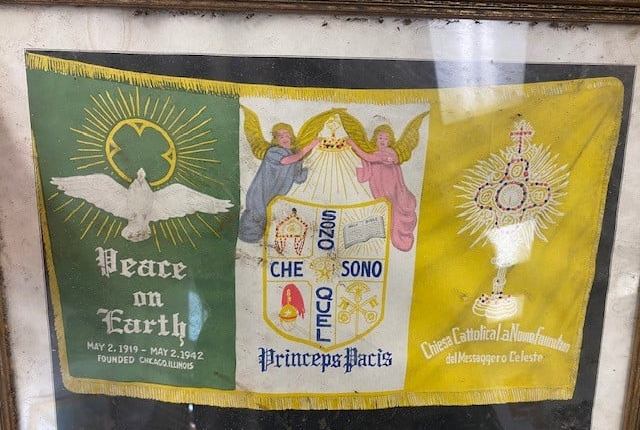
In 1917, Abbate founded a formal church organization. It was called La Chiesa Cattolica di Nuova Gerusalemme del Messaggiero Celeste (the New Jerusalem Catholic Church of the Celestial Messenger). In Italian, the word is usually spelled “messagero,” but, for some reason, the Church always used “messagiero.” At about the same time, Abbate also established a male religious order, the Order of the Celestial Messenger.

Continue reading “Images of the Celestial Messenger. Part 2.”

Images of the Celestial Messenger. Part 1.

Images of the Celestial Messenger. Part 1.

Giuseppe Maria Abbate (1886-1963) was the founder and leader of the New Jerusalem Church of the Celestial Messenger, based in Chicago. He was also God. In 2018, I co-authored a book about him. A few years later, I wrote a group profile for the World Religions and Spirituality Project, summarizing Abbate’s and his Church’s history and beliefs. At the time, we thought the Church’s archives had been destroyed in the early 1990s and had to rely mainly on secondary sources, including press material.

However, in 2021, something remarkable happened. I was contacted by a Chicago antique dealer who had bought a bulk of strange papers and objects as part of an estate. It proved to be a central part of Abbate’s archive! Some 100 kilos of material. The collection had been hidden away in a garage for about three decades. With the help of the Department of Theology at Uppsala University, I acquired the collection.

The discovery of the archive enables the study of the history of the Celestial Messenger and the detailed analysis of his theology and the religious practices of his Church. This is an ongoing project, and the results will be published in specialized works. However, here and in a series of posts that follow, I will briefly introduce the biography and ministry of the Celestial Messenger through a selection of the many images and photos that the Church distributed to members and potential followers.

In this first post, we follow Abbate from his birth in 1886 to the formal organization of his Church in the late 1910s. With time, Abbate’s official biography and self-understanding developed. Through much of the 1910s, he understood himself as a special envoy from heaven or a heavenly being with supernatural powers. However, in the 1920s, he became convinced of his pre-existence: he had lived on Mars before coming to earth. It also became increasingly clear that he believed he was the reincarnated Christ; that he was God. In this text, however, I will not include the elaborated biography presented in later church publications; instead, I will use the version he disseminated in the late 1910s.

Continue reading “Images of the Celestial Messenger. Part 1.”

Uppsala Studies in Church History

Uppsala Studies in Church History

In 2017, the Department of Theology at Uppsala University launched a new open-access book series, Uppsala Studies in Church History. To date (June 2025), we have published 20 volumes: ten in English and ten in Swedish. The titles focus on both Swedish and international themes.

Uppsala Studies in Church History is an e-book series published by the Department of Theology, Uppsala University. It includes both works in English and in Swedish. The volumes are available open-access and only published in digital form on http://www.diva-portal.org.

Uppsala Studies in Church History är en skriftserie som utges vid Teologiska institutionen, Uppsala universitet. Serien innehåller arbeten på såväl svenska som engelska. Skrifterna i serien är fritt tillgängliga och utges endast i digital form på http://www.diva-portal.org.

Click on the hyperlinks below to get access to the full texts.

Continue reading “Uppsala Studies in Church History”